
Ceramic & Porcelain Tile
Tile Flooring
Read more403 Navaho Dr, Frederick, MD 21701

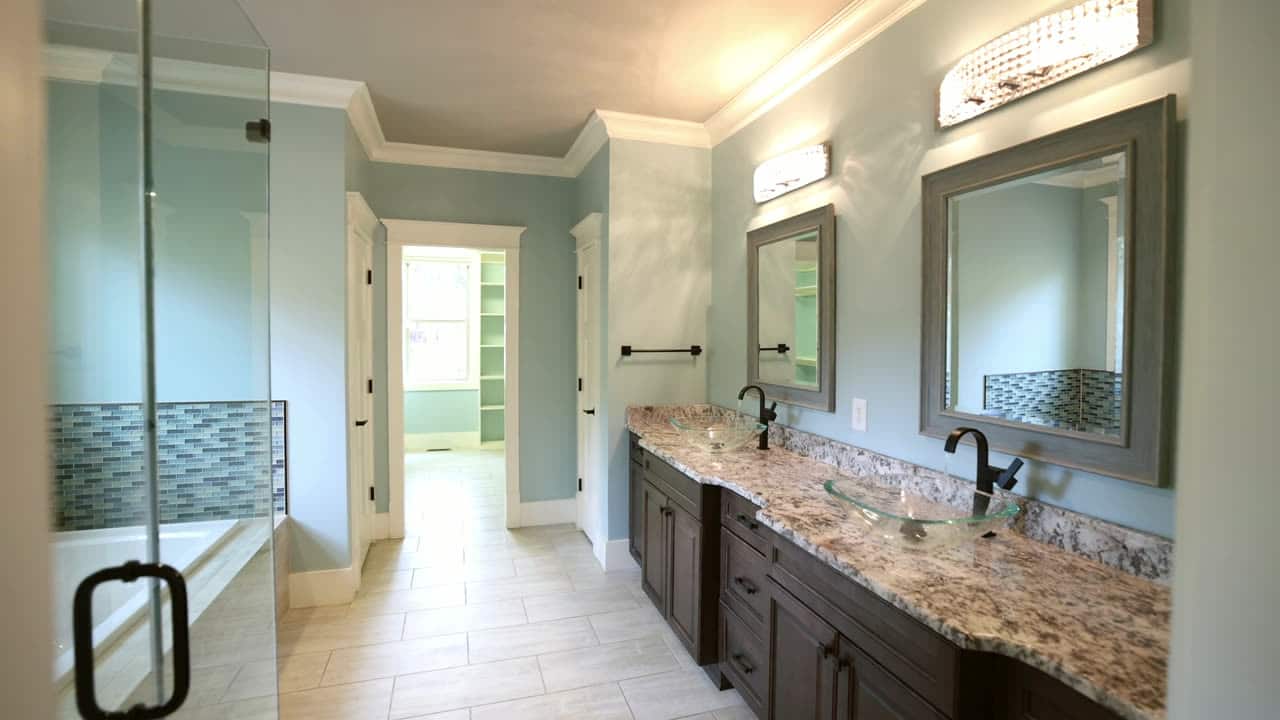
Bathroom Remodeling costs in Maryland
Powder room to primary suite, with the budget broken down line by line — and an honest account of the three decisions that move a bathroom from twenty thousand to forty.
Quick answer
A bathroom remodel in Maryland typically costs $14,000 to $28,000 for a full hall bath with standard finishes, $4,000 to $9,000 for a powder room, and $28,000 to $60,000 or more for a primary bath with mid-to-high finishes. Moving plumbing, converting a tub to a walk-in shower, and the tile specification are the three decisions that most change the number.
The numbers
Almost no contractor site in this market publishes a number, which is exactly why the question has so much search demand and so little honest supply. These are the ranges we price to in Maryland, with the reason each one is a range and not a price.
Typical in Maryland
Full hall bath, standard finishes
$14,000 – $28,000
$4,000 – $9,000
No tub, no shower, no waterproofing. Vanity, toilet, floor, paint, lighting. The cheapest meaningful remodel in a house.
$14,000 – $28,000
Typical 5×8 or 5×10, everything replaced, fixtures staying roughly where they are. This is the number most Maryland homeowners are actually asking about.
$28,000 – $60,000+
Larger footprint, double vanity, separate shower, often a freestanding tub. The finishes rather than the size are what carry the top of this range.
$7,000 – $18,000
The most requested single change we see. The spread depends on whether the drain has to move and how the new shower is waterproofed.
$900 – $2,500
Higher in an upstairs bathroom and higher again over an old mortar-bed floor.
$1,500 – $3,500
Replacing valves and supplies in the same locations. This is the cheap version of plumbing.
$3,500 – $9,000
Moving a toilet or a shower drain means opening the floor and re-running waste with the fall it needs. On a slab or a finished ceiling below, it is the single most expensive line on the page.
$900 – $3,000
A modern bathroom needs a properly sized extraction fan ducted to outside. In a Maryland summer, an underspecified fan is how a new bathroom grows mould in its first year.
$3,500 – $9,500
See the tile cost guide for the per-square-foot breakdown. Pattern and format move this line more than material price does.
$900 – $6,000
A stock 36-inch vanity with a cultured top against a custom double vanity with a stone top. Nowhere in a bathroom is the price spread wider or the decision more purely aesthetic.
$900 – $3,500
A framed sliding door against custom frameless. Frameless is templated after the tile is set, which is a two-to-three week wait — plan for it.
$1,200 – $2,600
The upgrade people mention unprompted years later. Only possible while the floor is open, so it is now or in fifteen years.
$800 – $6,000
Not on any quote, and the reason a contingency exists. Old tiled showers leak slowly; what is under them is not known until the tile is off.
Ranges, not quotes. Published 2026 and reviewed against work we are actually pricing in Maryland. What your job costs comes from a walkthrough — access, condition, height and finish level move a price more than square footage does. Estimates are free and in writing.
The same 5×8 bathroom can honestly be quoted at either end of that range, and it is worth understanding what separates them, because it is not markup.
At the bottom: fixtures stay exactly where they are, a stock vanity, a framed shower door, a straight-lay porcelain floor and a simple tiled tub surround, standard lighting. Everything is new and everything is done properly — this is a good bathroom, not a compromised one.
At the top: the tub becomes a walk-in shower, which moves a drain. Frameless glass, templated after the tile. A niche and a bench, both of which are waterproofing details rather than decoration. Large-format or patterned tile. A heated floor. Better fixtures, a stone top, a fan that is actually sized for the room. Each of those is one to three thousand dollars, and five of them is the whole gap.
The useful exercise before you get quotes is to decide which two of those you actually want, rather than discovering them one at a time during the job. Changes made mid-project cost more than the same choices made at planning, every time.
Ten to fifteen percent, held separately from the quote. This is not pessimism about the contractor — it is arithmetic about old houses. Bathrooms are the room most likely to have been quietly leaking, and what is under a twenty-year-old tiled shower is genuinely unknown until the tile comes off.
The most common finds in Maryland houses of this age are a soft subfloor under the shower or around the toilet flange, waste piping that will not accept a modern connection without being replaced back to a joint, and no vent where a vent should be. Those are $800 to $6,000 items and they are not negotiable once exposed.
What you should expect from a contractor is that the discovery is shown to you, photographed, priced as a written change order before the work happens, and not buried. What you should not expect is a quote that anticipated something nobody could see.
Before you sign anything
Ask every contractor for these in writing. Quotes only compare once they do — and Maryland law requires home improvement work over $500 to be under a written contract anyway.
Want the number for your house?
Call and describe the job. You’ll get a straight answer on whether it’s something we do and roughly what it runs, before anyone books a visit.
(301) 524-1729
Priced by us, not a calculator
Bathroom Remodeling
What moves the number
Usually not because one contractor is expensive. Usually because they are pricing different work. These are the variables that actually move it.
This is the biggest single lever on a bathroom budget. Keeping the toilet, sink and shower drains where they are keeps plumbing at $1,500 to $3,500. Moving them means opening the floor, re-running waste at the correct fall, and — on a slab or above a finished ceiling — considerable collateral work. It can be a $6,000 swing on an otherwise identical bathroom.
Homeowners agonise over $4 versus $9 tile. On a bathroom that is a few hundred dollars. Choosing herringbone over a straight lay, or a mosaic shower floor over large-format, changes labour by 30 to 80 percent — which on $3,500 to $9,500 of tile labour is the larger number by far.
Frederick and Montgomery County have a lot of housing stock from before 1980. Galvanised supply lines, cast-iron waste, undersized venting, no dedicated circuits and occasionally knob-and-tube in the walls all get discovered at demolition. None of it is optional to fix once found, and none of it is visible at quoting.
A second-floor bathroom has a finished ceiling below it, which is both a protection problem during the work and a constraint on where the waste can run. A slab-on-grade bathroom means any drain relocation involves cutting concrete. Both are real cost differences from a basement bathroom with an open ceiling below.
A full bathroom remodel is typically three to five weeks, and most of that is not people working in your house — it is waiting for the shower glass template, a special-order vanity, or an inspection. A single-bathroom household paying for that time in inconvenience should be honest about it at planning, because "can we do it faster" usually means "can we do it worse".
On the job
Trade photography, stage by stage — the work these numbers buy. Photos of our own recent jobs come out at the walkthrough, on the actual house.


Straight answers
Not covered here? Call and ask — you’ll get a real answer, not a “depends on the job”.
A standard 5×8 hall bath typically runs $14,000 to $28,000 for a full remodel. A powder room with no shower or tub — and therefore no waterproofing — is much cheaper at $4,000 to $9,000. Small does not mean cheap in a full bath: the fixture count and the waterproofing are the same as in a large one.
Three to five weeks for a full bath, and a meaningful part of that is waiting rather than working — shower glass is templated after the tile is set and takes two to three weeks to come back, and special-order vanities and tile have their own lead times. Ordering everything before demolition starts is the single best thing you can do for the schedule.
For daily comfort and accessibility, most homeowners who do it say yes. On resale, keep one bathtub somewhere in the house — buyers with young children look for it, and a house with no tub at all can narrow your market. Converting the hall bath while keeping a tub in the primary, or vice versa, is the usual compromise.
For cosmetic work — replacing a vanity, retiling, painting — generally not. Anything that touches plumbing, electrical or structure does, in every Maryland jurisdiction we work in, and that covers most real remodels. Your county permit office is the authority. Unpermitted plumbing work is a routine finding at resale inspection and an expensive one to resolve retroactively.
Sometimes, on the sticker price. Be aware of what you take on: you own the lead times, the returns, the wrong-size vanity, and the warranty conversation if something fails. The most common way this costs money rather than saving it is a fixture that arrives late or damaged and stalls a booked crew. Supplying your own vanity and light fittings is usually fine; supplying your own valves and drains rarely is.
While the crew is there

Talk to the people doing the work
Tell us what needs doing. We’ll walk it with you, sequence every trade it touches, put the price in writing, and leave you to decide.
Get a quote
Two short steps. No obligation, no pressure — just a clear number and a straight answer about what the job involves.


Tick as many as you like. Most jobs are two or three of them at once, and I sort out the detail when I come and look. Nobody gets turned away for choosing the wrong box.


