
Ceramic & Porcelain Tile
Tile Flooring
Read more403 Navaho Dr, Frederick, MD 21701

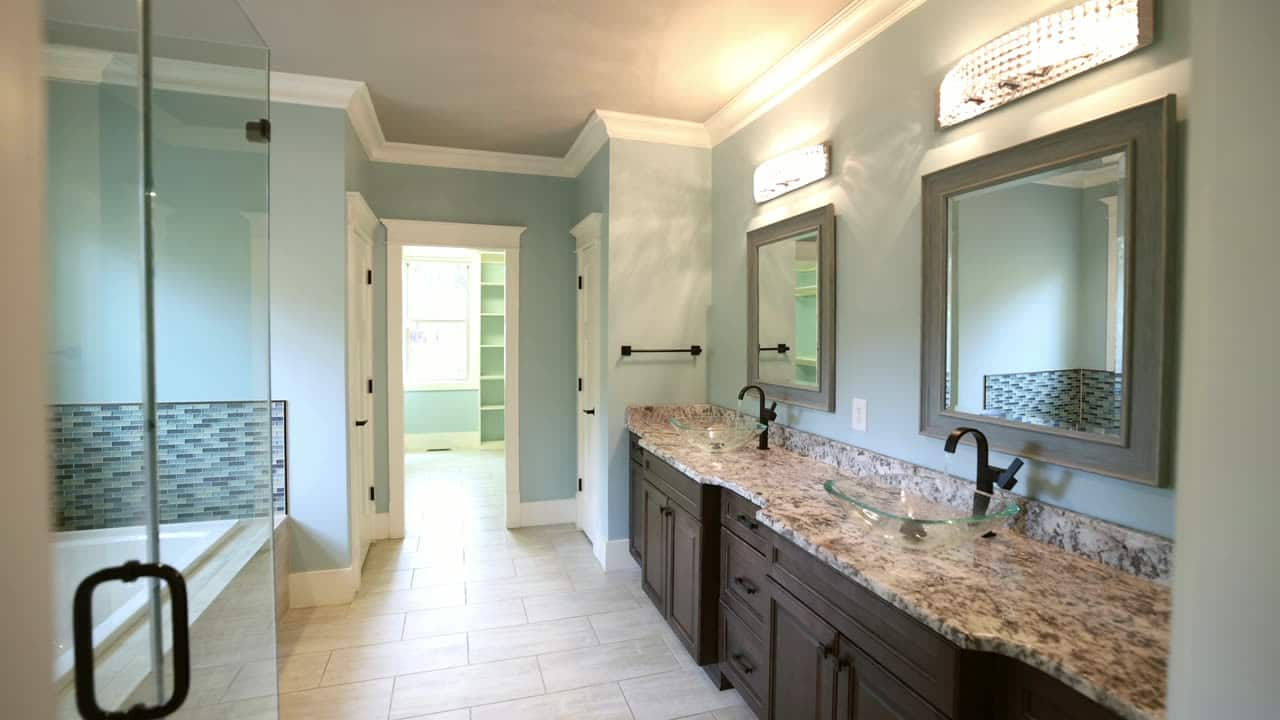
Walk-in showers costs in Maryland
A walk-in shower built in place is one of the few bathroom items where the construction is the predictable part and the selections are not. Tile and glass move these numbers more than framing and waterproofing do, which is good news: it means the quality of what is behind the tile is affordable, and the decisions that cost money are the ones you can see.
Quick answer
A tiled walk-in shower in Maryland costs $8,000 to $15,000 for a standard sixty-inch alcove, $12,000 to $24,000 for a large walk-in with a glass panel, and $14,000 to $26,000 for a curbless build where the floor is recessed. Niches, benches and frameless glass are priced separately. Replacing an existing tub with a shower in the same alcove is a narrower job and has its own guide.
The numbers
Almost no contractor site in this market publishes a number, which is exactly why the question has so much search demand and so little honest supply. These are the ranges we price to in Maryland, with the reason each one is a range and not a price.
Typical in Maryland
Standard 60 inch alcove, tiled walk-in shower
$8,000 – $15,000
$8,000 – $15,000
Demolition, framing corrections, waterproofing, tile, valve and trim. The commonest Maryland walk-in and the baseline for everything below.
$12,000 – $24,000
A wider footprint, more wall area in tile, and a fixed panel instead of an enclosure. Most of the increase is tile quantity and glass.
$14,000 – $26,000
The floor structure is opened and the subfloor dropped so the shower floor sits flush. Possible on most joisted floors, rarely on a slab without raising the whole room.
$12,000 – $22,000
Lower than the figure above because the footprint, the rough-in and the drain are already there. Deliberately kept apart from the new-build number — see the tub-to-shower guide.
$18 – $35 per square foot
The rate behind the totals. Large-format and stone sit at the top; a standard ceramic subway on a flat wall at the bottom.
$350 – $800
Framed, waterproofed as part of the wall assembly, and tiled. Two niches cost less than twice one because the setup is shared.
$600 – $1,500
Sloped to drain, waterproofed as a continuous surface with the floor and wall. A bench is a waterproofing detail first and a seat second.
$1,400 – $3,800
Measured after the tile is set, never before. Thickness, hardware finish and whether the opening is square decide where in the band it lands.
+$400 – $1,100
Allows a single-plane floor slope, which is what makes large-format floor tile work in a shower. Worth it with big tile, optional otherwise.
$120 – $320 each
Cheap now, expensive later. Blocking at the framing stage means a bar can be fitted properly at any point in the next thirty years.
$450 – $1,600
A pressure-balancing valve at the low end, thermostatic with a diverter and a second outlet at the high end.
$12 – $22 per square foot
Priced on the whole room rather than the shower. Fitted with its own thermostat circuit and tested before tile goes down.
$450 – $2,400
Quoted when found, with a photograph, never absorbed silently. A failed shower pan has usually been wetting the framing for years.
Ranges, not quotes. Published 2026 and reviewed against work we are actually pricing in Maryland. What your job costs comes from a walkthrough — access, condition, height and finish level move a price more than square footage does. Estimates are free and in writing.
The part of a shower that decides whether it lasts twenty years is invisible when the job is finished. A sheet or liquid-applied waterproofing membrane taken up the walls and bonded continuously to the floor assembly, a pan sloped properly to the drain, corners and changes of plane treated as the places failure begins, and a niche or bench waterproofed as part of the wall rather than cut into it afterwards.
None of that is expensive relative to the tile in front of it. It is the cheapest insurance in a bathroom, and it is the first thing a very low quote has left out. There is no way to inspect it once the tile is set, which is why it belongs in the written scope by name — the membrane system, where it goes, and how the corners are treated.
The tile cracks and loose tiles post on our blog covers what failure looks like from the outside. In a shower, it almost never starts with the tile.
A walk-in shower and an accessible shower are not the same specification. A curbless entry is the headline item, but a shower that will still work in twenty years also wants a clear opening wide enough to pass through, blocking in the walls for grab bars, a bench or a space for a seat, a hand shower on a slide bar, and a valve placed where it can be reached from outside the spray.
The blocking is the item worth fitting now whether or not bars go up today. At $120 to $320 a position during framing, it is a fraction of what opening a finished tiled wall later costs, and it means a bar can be fitted into solid timber rather than into a hollow wall with an anchor.
Curbless also asks more of the drainage. A single-plane slope to a linear drain is easier to walk on and easier to tile in large format than a four-way slope to a centre drain, which is why the linear drain row exists at $400 to $1,100 rather than being bundled.
If there is a tub in an alcove today and the intention is a shower in the same footprint, that is a conversion. The footprint, the rough-in and usually the drain are already there, and the job runs $7,000 to $18,000 with its own breakdown on the tub-to-shower conversion page. A curbless version of that conversion is $12,000 to $22,000.
If the shower is going somewhere there was not one, is getting materially bigger, or sits in a bathroom being taken back to studs, that is this page. The curbless figure here is higher at $14,000 to $26,000 for a straightforward reason: nothing is being reused.
Both numbers are honest and they are not the same number. Any contractor quoting a single figure for both has not asked which one you are doing.
Before you sign anything
Ask every contractor for these in writing. Quotes only compare once they do — and Maryland law requires home improvement work over $500 to be under a written contract anyway.
Want the number for your house?
Call and describe the job. You’ll get a straight answer on whether it’s something we do and roughly what it runs, before anyone books a visit.
(301) 524-1729
Priced by us, not a calculator
Bathroom Remodeling
What moves the number
Usually not because one contractor is expensive. Usually because they are pricing different work. These are the variables that actually move it.
The same shower in a standard ceramic subway and in a book-matched large-format porcelain are separated by thousands of dollars, almost all of it in labour rather than material. Large tile needs a flatter substrate and more careful layout; stone needs sealing and is unforgiving of a layout that puts a cut where the eye lands. The construction behind both is identical.
A curb is a piece of framing and a strip of tile. A curbless entry means opening the floor structure and dropping the subfloor so the finished shower floor sits flush with the room, then re-establishing slope within that recess. On a joisted floor it is routine. On a slab it generally means raising the whole bathroom floor, and that changes doors, thresholds and sometimes the vanity.
Frameless glass runs $1,400 to $3,800 and is templated after the tile is set, because glass is cut to the opening that exists rather than the one on the drawing. A quote that prices glass before tiling is pricing an assumption. The cost moves with thickness, hardware, and how far out of square the opening turns out to be.
A shower being replaced has usually been leaking in a small way for a long time. Rot at the plate, a soft subfloor at the threshold and a joist with water damage are common findings, at $450 to $2,400 to put right. It is the one part of a bathroom number that cannot honestly be fixed in advance, which is why it is quoted on discovery with a photograph.
Keeping the valve and the drain where they are is the cheapest shower. Moving the drain means access to the ceiling below. Moving the valve to another wall means opening that wall and re-running supply. Neither is expensive in isolation; both are worth deciding before demolition rather than during it.
Straight answers
Not covered here? Call and ask — you’ll get a real answer, not a “depends on the job”.
A standard sixty-inch tiled alcove runs $8,000 to $15,000. A large walk-in with a glass panel is $12,000 to $24,000, and a curbless build with the floor recessed is $14,000 to $26,000. Niches, benches, frameless glass and a linear drain are priced on top as their own lines.
Because the floor structure is opened and the subfloor dropped so the shower floor finishes flush with the room, then slope is re-established inside that recess. On a joisted floor that is routine work. On a slab it usually means raising the whole bathroom floor, which affects doors and thresholds.
Yes, usually by a few thousand dollars, because the footprint, rough-in and drain already exist. A tub-to-shower conversion runs $7,000 to $18,000, or $12,000 to $22,000 curbless. A new or enlarged walk-in starts at $8,000 and reaches $26,000 curbless.
Frameless panel and door is $1,400 to $3,800. It is separate because it is templated after the tile is set — glass is cut to the opening that exists, not the one on the drawing. Anyone pricing glass before tiling is pricing a guess.
Partly, and much more cheaply if blocking for grab bars goes in during framing at $120 to $320 a position. A curbless entry, a wider opening and valve placement are decisions that are difficult and expensive to revisit once tile is set, so they are worth settling now even if bars are not going up today.
While the crew is there

Talk to the people doing the work
Tell us what needs doing. We’ll walk it with you, sequence every trade it touches, put the price in writing, and leave you to decide.
Get a quote
Two short steps. No obligation, no pressure — just a clear number and a straight answer about what the job involves.


Tick as many as you like. Most jobs are two or three of them at once, and I sort out the detail when I come and look. Nobody gets turned away for choosing the wrong box.


