


Interior & Exterior Painting
Painting
Read more403 Navaho Dr, Frederick, MD 21701

Finishing · From the field
A brown ring on the ceiling is the most commonly ignored warning in the American home. Sometimes it is a dead leak that only needs paint; sometimes it is live and feeding mold you cannot see. Here is how to tell which one you have, from a crew that repairs both.
Quick answer
A ceiling stain means water got into the drywall from above and dried, leaving its minerals behind as a brown ring. The source is one of three things: a roof or flashing leak, a plumbing leak from a bathroom or supply line above, or condensation from an unsealed duct or exhaust fan. Find and fix the source first — a stain that gets painted while the leak lives comes back through the new paint.

The brown ring is a tide mark. Water soaked into the drywall, spread until it ran out of momentum, and evaporated — leaving behind the minerals, tannins and rust it picked up traveling through roofing, framing lumber or old pipe. The color is the water’s travel diary, which is why roof water, pipe water and condensation all stain a little differently, and why the ring’s edge is darkest: that is where the evaporation finished.
The first question is not “what caused it” but “is it live?” Press the center gently: soft, damp or sagging board is an active problem that wants attention this week, because saturated drywall grows mold on its back face within days. If it is dry and hard, date-stamp it — draw a pencil line around the stain’s edge and photograph it. If the stain grows past your line after the next hard rain or the next month of showers upstairs, it is live. If it never moves, you are looking at a scar from a leak that may already be fixed or a one-time event.
One caution before the pencil trick lulls anyone: a stain can be dry for months because the leak only runs under specific conditions — wind-driven rain from the east, the second shower of the morning, the AC’s longest cycles in July. “Dry today” is evidence, not a verdict.
Location is the best detective. A stain under an attic points up through it at the roof — but almost never straight up, because water runs along rafters and the underside of decking before it drops, so the roof entry point is routinely several feet upslope from the stain. Stains near chimneys and around bathroom exhaust penetrations are flashing and boot stories; stains at the ceiling’s edge on an exterior wall in February are often ice-dam backup, the classic Maryland winter special that the gutters post on this blog covers in detail.
A stain under a bathroom is a plumbing story until proven otherwise, and the suspects rank in order: the toilet’s wax ring (stains near the fixture, worse after use), the tub or shower drain connection, the valve in the wall, and — in houses of a certain age around Myersville, Middletown and the older parts of Frederick — the supply lines themselves. The photo on this post is from one of our own jobs: original galvanized steel stubs opened up inside a wall, rotted from the inside out after decades. Galvanized pipe fails by slow constriction and pinholes, and a pinhole mists a stud bay for months before the ceiling below says anything.
The third suspect needs no storm and no fixture: condensation. An uninsulated AC duct running through a humid Maryland attic sweats all summer and drips on schedule every afternoon; a bathroom fan that exhausts into the attic instead of through the roof rains its moisture back onto the ceiling all winter. Condensation stains show up in the same seasons every year, without weather events, and fixing them is insulation-and-ducting work, not roofing or plumbing.
Everything about repairing the ceiling is easy compared to the discipline of not repairing it first. Paint, patch or replace the board while the leak lives, and the stain returns through the new work in a season — with interest, because the water kept working the whole time. Every callback we have ever seen on a stain repair traces to a source that was assumed fixed rather than confirmed fixed.
Confirming is usually cheap. For plumbing suspects, run the fixture above deliberately — flush repeatedly, fill and drain the tub, shower with someone watching the stain — and for supply-side leaks, watch the water meter with everything off. For roof suspects, a hose on the roof section above, run in stages from downslope up, finds the entry without waiting for weather. For condensation, the attic itself testifies: sweating ducts, a fan hose lying disconnected in the insulation, matted insulation under a duct run.
This diagnose-first sequence is also where a multi-trade crew earns its keep on what looks like a small job. A stain traced to flashing needs a roofer; traced to a wax ring needs a plumber — on our jobs, the licensed plumbing is handled by a licensed plumber while our crew opens and closes the walls around it; traced to a duct needs neither. Being able to open the ceiling, fix what is found, and close it under one contract is the difference between a repair and a month of coordinating three companies over one brown ring.
Once the source is dead, the repair has tiers. A cosmetic scar — dry, hard board, intact paper — does not need surgery: it needs a stain-blocking primer, and this detail is non-negotiable. The tannins in a water stain bleed straight through ordinary latex paint, coat after coat; a shellac or oil-based stain-blocking primer seals them permanently, and then the ceiling paint goes over it. Half the “the stain came back” stories are really “nobody primed it” stories.
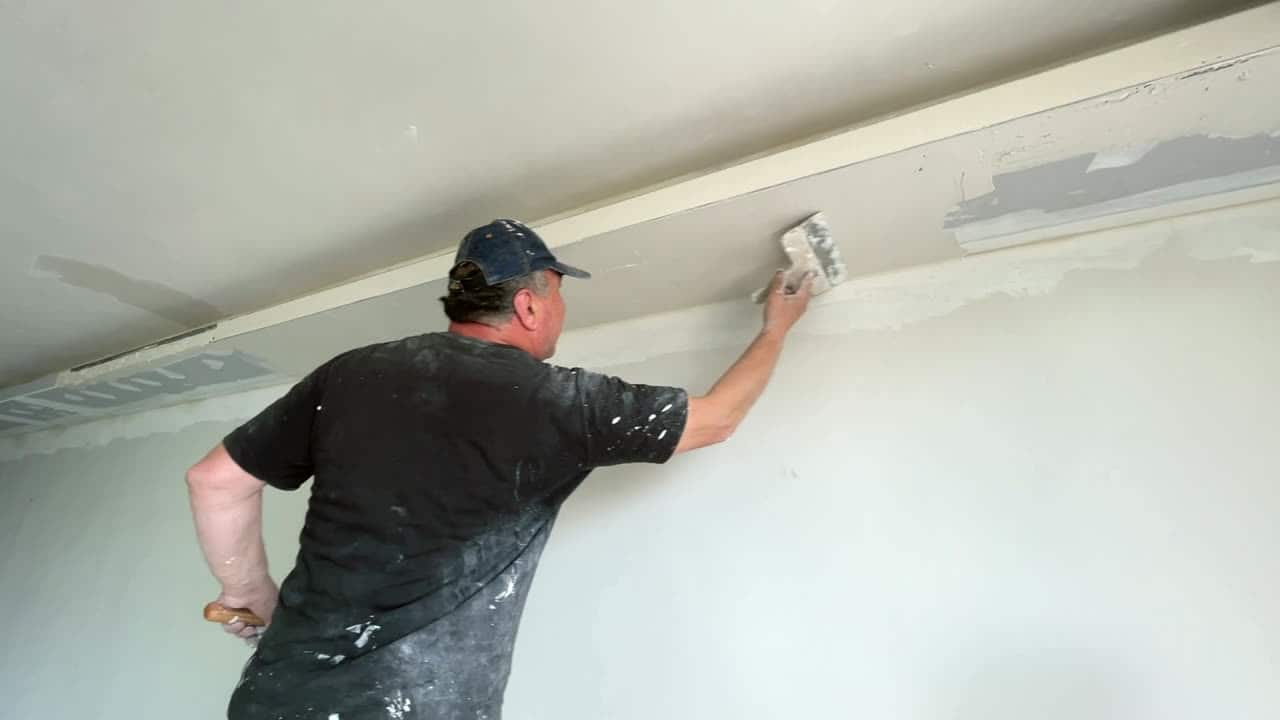
Wet, soft, sagging or moldy board comes out, and the cut goes to clean, dry material — not just past the visible stain, because the wetting always ran wider than the ring. The bay above gets inspected while it is open (wet insulation is replaced; it never dries in place), the new board goes in on proper backing, and then comes the part that separates a patch from a repair: the finish. Feathering joint compound so a patch disappears in raking light is exactly the skill drywall finishing is, and ceilings are the hardest surface in the house to hide a patch in, because evening light rakes across them and reveals everything.
The last step is texture and paint matching. A smooth ceiling patch gets skimmed wide and painted corner to corner — painting only the patch leaves a sheen ghost even with the same can of paint. A textured ceiling gets its texture matched, which is a genuine craft skill, and in pre-1980s houses the existing texture should be tested for asbestos before anyone sands it; a lab test costs little and is the kind of thing a careful contractor insists on rather than shrugs at.
People search “home repair near me” from Myersville, Middletown, Jefferson and the towns along the mountain because the project in front of them is too small for the big remodelers to return calls about and too skilled for a guess: a stained ceiling, a cracked settlement line over a doorway, a door that quit latching, nail pops marching down a hallway after the house’s first dry winter. These are exactly the jobs a self-performing crew can slot in, because the same people run our large jobs and the skill transfers straight down.
The economics of small repairs favor batching, and it is the one piece of advice we give every small-job caller: walk the house first. The visit that fixes the ceiling stain can fix the hallway nail pops, re-caulk the tub surround and adjust three doors in the same day, and the cost per item drops steeply after the first, because showing up is a fixed cost. A one-page list taped to the fridge for a month makes a better service call than three separate phone calls ever will.
And if the stain turns out to be the visible corner of something bigger — a re-roof, a bathroom floor gone spongy, a supply-line replacement — you are already talking to a crew that does that work, with no incentive to inflate a primer-and-paint job into one. The repair that is small stays small; the one that isn’t gets diagnosed honestly. That is the whole pitch.
If you only skim
The trade behind this post
Drywall Finishing & Repair
Reading because you have this exact problem? Call and describe it. You’ll get a straight answer on whether it’s something we do and roughly what it runs.
(301) 524-1729See how we do finishingOn the job
Trade photography, stage by stage. Photos of our own recent jobs come out at the walkthrough, on the actual house.


Straight answers
Not covered here? Call and ask — you’ll get a real answer, not a “depends on the job”.
The stain itself is cosmetic; the questions behind it are not. A sagging, water-heavy ceiling can drop, saturated board grows mold within days, and water that traveled near wiring or fixtures deserves respect — if a light fixture sits inside the wet zone, stop using it until it is checked. A dry, old, stable stain is urgent like a filling, not like a fracture: schedule it, don’t ignore it.
Typically it covers sudden and accidental water — the burst pipe, the washing machine hose — including the ceiling, but not the slow leak that seeped for months, which policies treat as maintenance, and usually not the failed part itself. Photograph everything before repairs, keep the failed part if there is one, and report promptly; “how long has this been happening” is the claim’s central question.
Small, contained mold on removable materials — the back of a patch of drywall, a stretch of insulation — is handled as part of the repair: contain, remove, treat the framing, replace. Widespread growth, HVAC contamination, or mold in someone with health sensitivities is remediation-company territory, and we will say so plainly rather than scrape at something that needs containment protocols.
It spans from a primer-and-paint visit to a cut-and-replace with finish and full-ceiling paint, which is why the honest answer is a walkthrough rather than a phone number. The drywall repair page on this site carries the ranges we price to. The variable that moves cost most is not the hole — it is matching: texture matching and paint that has to disappear cost more than the board ever does.
Yes — Myersville, Middletown, Jefferson, Brunswick and the towns along US-40 and US-340 are inside our normal Frederick County working area, not the edge of it. Small jobs get slotted between larger projects, which is exactly why batching your list into one visit serves you: one trip, several fixes, and the trip charge stops mattering.
Keep reading
Other write-ups on this trade and the ones that usually come with it.
While the crew is there

Talk to the people doing the work
Tell us what needs doing. We’ll walk it with you, sequence every trade it touches, put the price in writing, and leave you to decide.
Get a quote
Two short steps. No obligation, no pressure — just a clear number and a straight answer about what the job involves.


Tick as many as you like. Most jobs are two or three of them at once, and I sort out the detail when I come and look. Nobody gets turned away for choosing the wrong box.


