


Bathroom Remodeling
Bathroom Remodeling
Read more403 Navaho Dr, Frederick, MD 21701

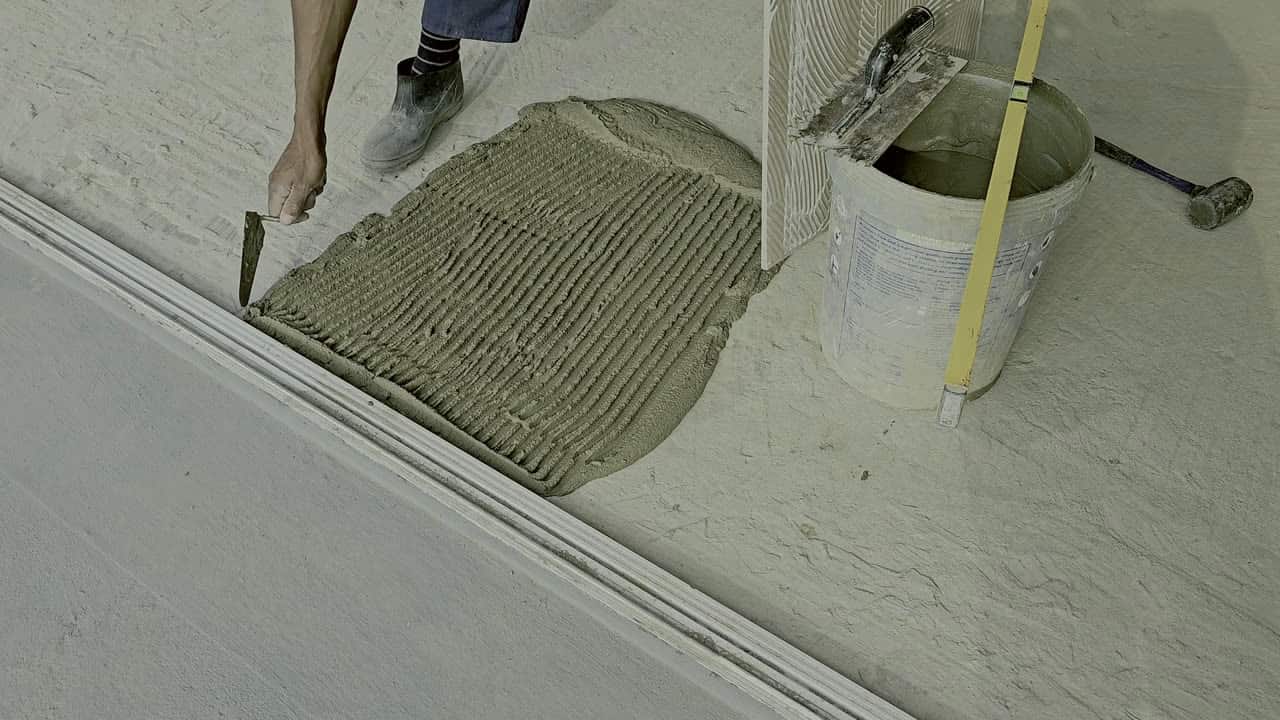
Tile Flooring · From the field
Tile is not waterproof and grout is not waterproof. Everything that keeps water inside a tiled shower happens in the layer underneath, before a single tile goes on the wall, and it is the part of the job nobody ever sees. Here is what is back there, which systems work, and what a tiling quote should say about it.
Quick answer
With a continuous waterproof membrane behind the tile — either a bonded sheet or liquid membrane over cement backer board, or a foam board system with sealed seams — carried through to a sloped pan that drains to the weep holes. Shower walls with waterproofing run $18 – $35 per square foot, and a typical alcove shower comes to $2,800 – $6,500 in tile labour.

Water goes through grout. It goes through it slowly, but it goes through it continuously for the life of the shower, and a tiled wall should be thought of as a decorative, hard-wearing rain screen rather than as a barrier. The barrier is behind it. If the barrier is continuous and correctly terminated, the small amount of water that gets past the tile is managed and drained. If it is not, that water goes into the framing.
This is why shower failures take years to appear and then appear catastrophically. There is no gradual symptom. The wall looks perfect while the bottom plate behind it rots, and the first visible sign is often a stain on a ceiling below or a tile that sounds hollow when tapped. By then the repair is not a tiling repair; it is a framing repair with a tiling repair on top of it.
So the honest way to read a shower quote is to read the part about what goes on before the tile. Everything else — the tile selection, the pattern, the grout colour — is a finish decision. The membrane and the pan are the structure, and they are the only part of the specification that determines whether the shower is still sound in fifteen years.
The first system that works is a bonded waterproof membrane over cement backer board: backer board screwed to the studs, seams taped and embedded, then either a sheet membrane bonded over the whole surface or two coats of a liquid-applied membrane brushed and rolled on, with reinforcing fabric at every corner and change of plane. Done properly this gives a continuous waterproof plane from the top of the tile line down into the pan.
The second is a foam board system — extruded polystyrene panels with a waterproof coating already bonded on, screwed to the studs with sealing washers and the joints sealed with a band and sealant. It is faster, lighter and marginally more expensive in materials, and the result is equivalent when the seams and penetrations are detailed correctly. Either of these is a correct answer.
What does not work is tile over greenboard or over ordinary drywall, and tile over backer board with no membrane at all on the theory that cement board does not rot. Cement board does not rot; the studs behind it do, and backer board passes water straight through. If a quote mentions backer board and stops there, the missing line is the membrane, and that line is the difference between a shower and a problem.
The floor of a tiled shower has to do two things at once: carry water that reaches the surface to the drain, and carry water that gets through the tile to the same drain at the level of the membrane. That is why a traditional mortar pan drains twice, and why the lower drainage path depends on small holes around the base of the drain body that must stay clear.
The classic failure is a mortar bed packed solid against those weep holes. The upper surface drains perfectly, the lower level fills, and the pan becomes a tray holding standing water against the bottom plate indefinitely. Protecting the weep holes with a layer of gravel or a purpose-made protector is a thirty-second job that nobody can inspect afterwards and that determines the lifespan of the pan.
Slope is the other half. A quarter-inch per foot of fall from the perimeter to the drain is the standard, achieved in the mortar bed or built into a pre-sloped foam tray, and it has to be continuous — a flat spot anywhere holds water, which shows up as persistent staining in the grout long before anything worse happens. Floor tile installed runs $8 – $18 per square foot of labour, and a smaller mosaic on a shower floor is slower, because it conforms to the slope properly where a large-format tile will not.
Every penetration and every change of plane is a potential failure point, and a niche is both. A recessed niche at $350 – $750 means cutting into the wall cavity, framing a box, waterproofing it as a continuous extension of the wall membrane including its own slight slope on the sill, and detailing every one of its internal corners. Done well it is invisible. Done badly it is a hole in the waterproofing with tile over it.
A tiled bench or seat at $450 – $1,100 is the same problem at a larger scale: a horizontal surface inside a wet area, with a top that must slope slightly towards the shower so water does not pool at the back, and a junction with the wall that has to remain sealed while two different pieces of structure move very slightly against each other. Benches built after the waterproofing rather than within it are a common and expensive mistake.
The other place leaks start is the curb, where a curbless conversion changes the problem entirely — the floor build-up and detailing for a curbless shower runs $1,400 – $3,800 on top, and it is largely a waterproofing and slope exercise rather than a tiling one. Our walk-in shower cost guide covers the figures and our tub-to-shower conversion guide covers the version where you are working inside an existing alcove.
Six things. The backer or board system by name. The waterproofing system by name — not just that it is waterproofed, but which membrane, because the systems are not interchangeable and mixing components from different manufacturers voids both warranties. The pan construction, and whether it is a pre-sloped tray or a site-built mortar bed. The slope. The niche and bench detail if there is one. And the movement joints at the internal corners, which should be a flexible sealant rather than grout.
That last one is small and consistently skipped. Grout is rigid and the corners of a shower are exactly where two planes move independently; grouting them produces a crack within a year or two, and the crack is a direct path through the tile layer. Silicone in the corners and at the floor-to-wall junction is the correct detail, and it is a line item that costs almost nothing and gets missed almost always.
Shower walls with waterproofing run $18 – $35 per square foot and a typical alcove shower comes to $2,800 – $6,500 in tile labour, with the spread driven by tile size, pattern and how much of the wall is going to be mosaic. Those are real numbers for the system described above. A number meaningfully below them is usually a number with no membrane in it.
If you only skim
The trade behind this post
Ceramic & Porcelain Tile
Reading because you have this exact problem? Call and describe it. You’ll get a straight answer on whether it’s something we do and roughly what it runs.
(301) 524-1729See how we do tile flooringWhat tile flooring costs in MarylandOn the job
Trade photography, stage by stage. Photos of our own recent jobs come out at the walkthrough, on the actual house.


Straight answers
Not covered here? Call and ask — you’ll get a real answer, not a “depends on the job”.
Shower walls including waterproofing run $18 – $35 per square foot, which puts a typical alcove shower at $2,800 – $6,500 in tile labour. A recessed niche adds $350 – $750, a built bench $450 – $1,100, and a curbless build-up $1,400 – $3,800. Those figures are labour and waterproofing; tile is selected and priced separately.
Technically sometimes, and we do not recommend it. You inherit whatever is behind the existing tile including the state of the waterproofing, you lose the chance to inspect the framing, and you raise the floor level relative to the drain and the curb. Showers are the one place where taking it back to the studs is nearly always the right call.
A correctly waterproofed shower should last the life of the bathroom — twenty years and more — with grout maintenance and resealing of the corner joints every few years. A shower that fails at five to eight years failed in the membrane or the pan, not in the tile, and that is not something grout sealer can address.
If you are staying in the house long term, frequently yes — it is the single most useful accessibility change in a bathroom and it looks better. The cost is in the floor: the structure has to be recessed or the whole floor built up, which runs $1,400 – $3,800 on top. In a basement bathroom on slab it is a different and larger conversation.
Yes. Tile and bathroom work are both self-performed — AS Home Solutions MD LLC self-performs fourteen trades, so the framing, the waterproofing, the tile and the finishing are the same firm rather than four subcontractors scheduling around each other. Frederick County and eight Maryland counties within about ninety minutes. Call (301) 524-1729.
Keep reading
Other write-ups on this trade and the ones that usually come with it.
While the crew is there

Talk to the people doing the work
Tell us what needs doing. We’ll walk it with you, sequence every trade it touches, put the price in writing, and leave you to decide.
Get a quote
Two short steps. No obligation, no pressure — just a clear number and a straight answer about what the job involves.


Tick as many as you like. Most jobs are two or three of them at once, and I sort out the detail when I come and look. Nobody gets turned away for choosing the wrong box.


