


Bathroom Remodeling
Bathroom Remodeling
Read more403 Navaho Dr, Frederick, MD 21701

Tile Flooring · From the field
A cracked tile is a symptom with about six possible causes, and the one thing it is almost never is a defective tile. How to tell movement from a bad bond from a substrate that was never flat, and why that distinction decides whether a repair lasts.
Quick answer
Almost always because of something under it rather than the tile itself. The four usual causes are movement in the substrate that the tile had no way to absorb, a bond that was never continuous because the adhesive was not properly combed or had skinned over before the tile went down, a substrate that was not flat enough for the size of tile being set, and water that has been getting into the assembly for long enough to break the bond down. Each one leaves a different pattern, and the pattern is how you tell them apart before anyone starts lifting anything.

Porcelain and ceramic tile are harder and more dimensionally stable than nearly anything else in a house. A tile sitting on a flat, rigid, properly bonded bed will outlast the kitchen it is in. That is why a cracked floor is almost always a message about the assembly rather than the surface — something below moved, or was never fully in contact, or got wet and stayed wet. The tile is just the part that is brittle enough to show it.
This matters practically, because the commonest repair request we get is to replace the cracked tiles. On its own that fixes the appearance and nothing else. If a floor cracked because a subfloor deflects when somebody walks across it, a new tile in the same place will crack in roughly the same way on roughly the same schedule. The repair that lasts always has two halves, and the first half is finding out what happened.
The good news is that tile assemblies fail in recognisable ways, and most of the diagnosis can be done without taking anything up. A tap test with a knuckle or the handle of a screwdriver tells you where the bond is missing. The crack pattern tells you about movement. Where the crack sits relative to the room, the joists and the walls narrows it further. By the time we lift the first tile we usually already know what we are going to find, and the lifting is confirmation rather than exploration.
A single cracked tile in the middle of an otherwise sound floor, with no hollow sound around it, is usually impact — something heavy was dropped, or a point load sat on a small void. That is the cheapest case and often a genuine one-tile repair. It is also the least common of the ones we are called to look at, because a single cracked tile rarely bothers anyone enough to pick up the phone.
A straight line of cracks running across several tiles, often following a grout joint and sometimes continuing as a crack in the grout beyond, is movement. On a slab that usually means a crack in the concrete below that has telegraphed straight up through the assembly. On a timber floor it means deflection — the floor flexes, the tile cannot, and the assembly breaks along the line of greatest movement. Those are different problems with different fixes and both are substrate work, not tile work.
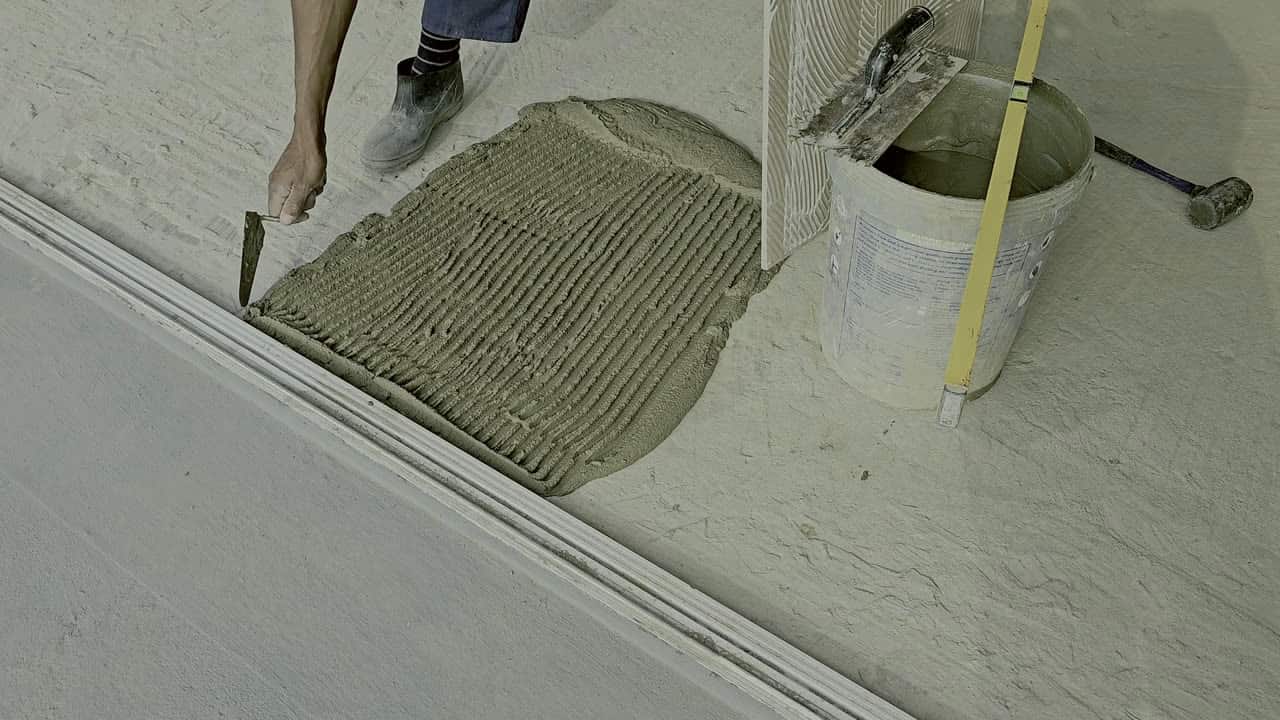
Hollow-sounding tiles, with or without cracks, mean the bond is missing. If the hollow patches are scattered and irregular, the adhesive was not combed out properly or was spotted on in dabs rather than fully troughed, so the tile was only ever in contact in places. If the hollow area is a consistent band — along a wall, around a doorway, across a whole section — it is more likely the adhesive had skinned over before the tiles went on, which happens when a large area is spread at once on a warm day.
And a row of tiles coming loose at the bottom of a shower wall, at the edge of a tub, or along a kitchen wall by a dishwasher is water. Water does not usually crack tile; it breaks down what the tile is stuck to, and then the tile comes away intact. Loose-but-unbroken tile in a wet area is the pattern that should worry you most, because the tile was the last thing to go and everything behind it has been going for a while.
Large-format tile has changed what a substrate has to be. A small tile can follow a gently undulating floor because each piece only spans a few inches, so the error per tile stays below what the eye and the grout joint can absorb. A tile measuring a foot or more across cannot follow anything — it is a rigid plane, and if the floor under it is not also a plane, the tile either rocks, sits on a void at the middle or the corners, or ends up standing proud of its neighbour at one edge.
That last one is lippage, and it is the complaint we hear most often about work somebody else did. A lipped edge is unpleasant underfoot, catches a mop and chips, and it is almost never a setting error on its own — it is a flat tile being asked to follow a floor that was out by more than the tile could absorb. The tolerance a tile wants gets tighter as the tile gets bigger, which is why self-levelling compound or a floated bed has become routine on large-format work rather than an upgrade.
So when somebody asks why one quote for the same tile is meaningfully higher than another, this is usually where the difference lives. A quote that includes getting the floor flat first, and a quote that assumes the floor is already fine, are quotes for two different jobs. The second one is cheaper right up until the point where the tile is down and the lippage is permanent. The Tile Council of North America publishes the industry tolerances, and they are worth knowing about before you pick a tile size.
Every tiled surface changes dimension slightly with temperature and moisture. Over a small bathroom floor that movement is negligible. Over a large open-plan floor, a floor with underfloor heating, a floor that runs through a doorway into another room, or a floor that meets a wall it is not bonded to, it is not negligible at all, and it has to go somewhere. If there is nowhere for it to go, it goes into a crack.
The provision for it is a movement joint — a flexible joint rather than a rigid grout line, placed at the perimeter where the floor meets a wall, at doorways and changes of plane, over any existing joint or crack in the slab below, and at intervals across large areas. It is cheap, it is unglamorous, it is slightly visible if you look for it, and it is left out of a great many residential tile jobs because it looks like an unnecessary line on an otherwise continuous floor.
When we are called to a long crack across a large tiled floor with no obvious movement below it, the missing perimeter joint is one of the first things we check. A floor grouted hard into the walls all the way round has been built as a single rigid plate with no room to expand, and the crack is the joint it made for itself, in the place of its own choosing rather than yours.
If the cause is impact or a small isolated void, the repair is genuinely local: cut out the grout, lift the tile without disturbing its neighbours, clean the bed back to a sound surface, and reset with the same adhesive and a colour-matched grout. The hardest part is usually matching the tile, which is why we always ask whether there are spares in a garage somewhere before anything else. A discontinued tile changes the conversation entirely.
If the cause is deflection or a moving slab, the repair has to address that first, and sometimes the honest answer is that a sound repair is not possible without taking up more than the cracked area. We would rather say that at the estimate than halfway through. An uncoupling membrane can absorb a surprising amount of in-plane movement on a slab and is often the right answer over a crack that has stopped moving, but it is not a fix for a floor that flexes underfoot.
If the cause is water in a wet area, the tile is the least of it. Loose tile at the bottom of a shower wall means investigating the waterproofing behind it, and that frequently means the repair is a rebuild of that part of the shower rather than a tile job. That is not an upsell, it is the difference between fixing a shower and re-covering a problem. We will show you what we find and let you decide with the evidence in front of you.
In all three cases the thing worth insisting on is that whoever quotes the work tells you what they think caused it. A quote that is only a list of tiles to be replaced is a quote from somebody who has not looked.
If you only skim
The trade behind this post
Ceramic & Porcelain Tile
Reading because you have this exact problem? Call and describe it. You’ll get a straight answer on whether it’s something we do and roughly what it runs.
(301) 524-1729See how we do tile flooringWhat tile flooring costs in MarylandOn the job
Trade photography, stage by stage. Photos of our own recent jobs come out at the walkthrough, on the actual house.


Straight answers
Not covered here? Call and ask — you’ll get a real answer, not a “depends on the job”.
Sometimes, and we will tell you honestly which case you are in. Where a tile cracked from impact or a small void and everything around it taps solid, a local repair is sound and we will do exactly that. Where the crack runs in a line, or the tiles around it sound hollow, a local replacement is cosmetic — the same thing will happen again in roughly the same place. The diagnosis costs nothing and it is the part that decides whether the repair is worth doing.
Because there is a void between the tile and the bed, so only part of the tile is bonded. That usually comes from adhesive that was spotted on rather than fully combed, or from adhesive that had skinned over before the tile was placed. Hollow tile is not an emergency and may last for years, but it is weak against point loads and it is the reason a tile cracks when something gets dropped on it. On a floor we would monitor it; in a shower it is worth looking at properly.
Almost never. Grout is a hard, brittle filler and it cracks where something moves. A repeating crack in the same line is telling you there is movement under that line, and the usual culprits are a joint or crack in the slab below, a doorway or change of plane, or a perimeter with no movement joint. Re-grouting it will look better for a season. Dealing with the movement, or converting that line into a proper flexible joint, is what stops it.
Flatter than most existing floors are, and the requirement tightens as the tile gets bigger. The industry tolerances are published by the Tile Council of North America and the practical consequence is simple: on large-format tile, getting the floor flat is a real line item and should appear in the quote. If it does not appear, either the floor was measured and found to be fine, or it was not measured. It is worth asking which.
Across Frederick County and Maryland within about 90 minutes of Frederick — eight counties from Hagerstown across to Annapolis, including Thurmont, New Market, Mount Airy and Middletown. Maryland only; we do not work in Washington, DC. Call (301) 524-1729, or send photos of the cracked area and a wider shot of the room through the quote form and we will tell you what we think we are looking at.
Keep reading
Other write-ups on this trade and the ones that usually come with it.
While the crew is there

Talk to the people doing the work
Tell us what needs doing. We’ll walk it with you, sequence every trade it touches, put the price in writing, and leave you to decide.
Get a quote
Two short steps. No obligation, no pressure — just a clear number and a straight answer about what the job involves.


Tick as many as you like. Most jobs are two or three of them at once, and I sort out the detail when I come and look. Nobody gets turned away for choosing the wrong box.


