


Drywall Finishing & Repair
Finishing
Read more403 Navaho Dr, Frederick, MD 21701

Painting · From the field
Paint fails on a schedule set by sun, moisture and the quality of the last prep job — not by the calendar on the can. Here is how often Maryland interiors and exteriors actually need repainting, when the exterior window opens and closes, and what separates a paint job from a prep job with paint on top.
Quick answer
In Maryland, exteriors need repainting every 5 to 10 years — wood siding at the short end, fiber cement and brick at the long end — and the work has to land between roughly late April and mid-October, when surfaces stay above 50°F overnight. Interiors run on traffic, not weather: hallways and kids’ rooms every 3 to 5 years, bedrooms and ceilings easily 8 to 10.

Exterior paint in Maryland lives in one of the harder climates American paint endures: humid subtropical summers that push moisture through walls from the inside, winter freeze-thaw cycles that flex every joint and hairline crack, and a full four-season swing that expands and contracts siding under the paint film year after year. Paint fails when the film loses that fight — chalking as UV breaks down the binder, cracking and alligatoring as the film gets brittle atop flexing wood, peeling where moisture gets behind it and pushes.
The material under the paint sets the clock. Wood siding and trim are the short end: five to seven years is honest for fully exposed wood in our climate, and south- and west-facing walls fail first, sometimes years before the shaded north side. Fiber cement holds paint beautifully — seven to twelve years — because it barely moves. Aluminum and vinyl can be painted (vinyl only in careful colors, since dark paint can overheat and warp it) and hold well. Brick, painted once, commits you forever, but repaints stretch past a decade.
Read the wall, not the calendar. Chalk on your palm after rubbing the siding means the binder is going; caulk pulling away at trim joints means water has found the way in; bare wood showing anywhere means the countdown has already started, because unprotected wood weathers fast, and every season of gray, checked wood adds sanding hours to the eventual job. The cheapest exterior repaint is the one done a year early; the most expensive is the one done two years late.
Paint chemistry sets a real window. Modern acrylics want surface and air temperatures above roughly 50°F for the entire cure — including overnight, which is what people miss: an October afternoon at 65 degrees followed by a 38-degree night ruins a coat that looked fine at dinnertime. On the other end, July in Maryland brings its own problems: paint applied to a sun-scorched wall at 95°F flashes off too fast to level or bond well, and afternoon thunderstorms can wreck a coat that needed a few more dry hours.
In practice the Frederick-area exterior season runs from late April to mid-October, and the best weeks are its shoulders — May, June, September, early October, when days are warm, nights are mild and humidity behaves. Good crews chase the sun around the house in high summer, painting the west wall in the morning and the east wall in the afternoon, and watch dew points in fall, because paint applied over morning dew is paint applied over water.
This narrow season is why exterior painting is booked months ahead, and why the smart sequence is to get quoted in late winter and hold a spring slot. Calling in August for exterior work often means painting in the riskier edge of October or waiting for the next season — and if the trigger was bare wood showing, waiting costs prep hours.
Inside, the schedule is about hands, furniture and steam rather than sun. Hallways, stairwells, kitchens and kids’ rooms take the abuse and honestly want paint every three to five years; adult bedrooms, dining rooms and ceilings go eight to ten looking fine. Bathrooms sit in the middle — not because of wear but because of moisture cycling, which is also why bathrooms deserve a bath-rated or higher-sheen paint rather than the flat that went everywhere else.
Sheen is the quiet decision that determines how a room ages. Flat and matte hide wall imperfections beautifully and touch up invisibly, but historically scrubbed poorly — though today’s premium matte paints wash far better than their ancestors. Eggshell and satin take cleaning in stride and suit halls and kids’ rooms; semi-gloss belongs on trim and doors, where its hardness and wipeability earn the extra shine. The classic mistake is high sheen on imperfect walls: gloss is a flashlight pointed at every roller mark and drywall flaw.
And interior painting has a season logic of its own, in reverse: winter is the smart time to book it. Crews that spend May through October on exteriors have their best people inside from November to March, scheduling is easier, and low winter humidity actually helps paint cure. The month everyone repaints for the holidays is the month to have booked in October.
The difference between a seven-year paint job and a three-year one is almost never the paint; it is everything that happened before the lid came off. A real exterior job starts with washing (paint over dirt and chalk bonds to the dirt and chalk, not the house), then scraping and sanding failed areas, feathering edges, spot-priming bare wood, replacing failed caulk at every joint and repairing the wood rot that prep uncovers. On the pre-1978 housing stock in downtown Frederick and the older towns, lead-safe practices are a legal requirement for disturbing old paint — an EPA RRP-certified approach, not a sander and a tarp.
Interior prep is smaller but just as legible in the result: nail pops set, cracks taped rather than smeared, glossy trim scuffed, stains sealed with the right primer, and everything masked properly. Because drywall finishing is one of our own trades, wall repair on our paint jobs is done by the people who do it for a living — a skim-coated patch under fresh paint disappears; a smeared one shadows through every coat after.
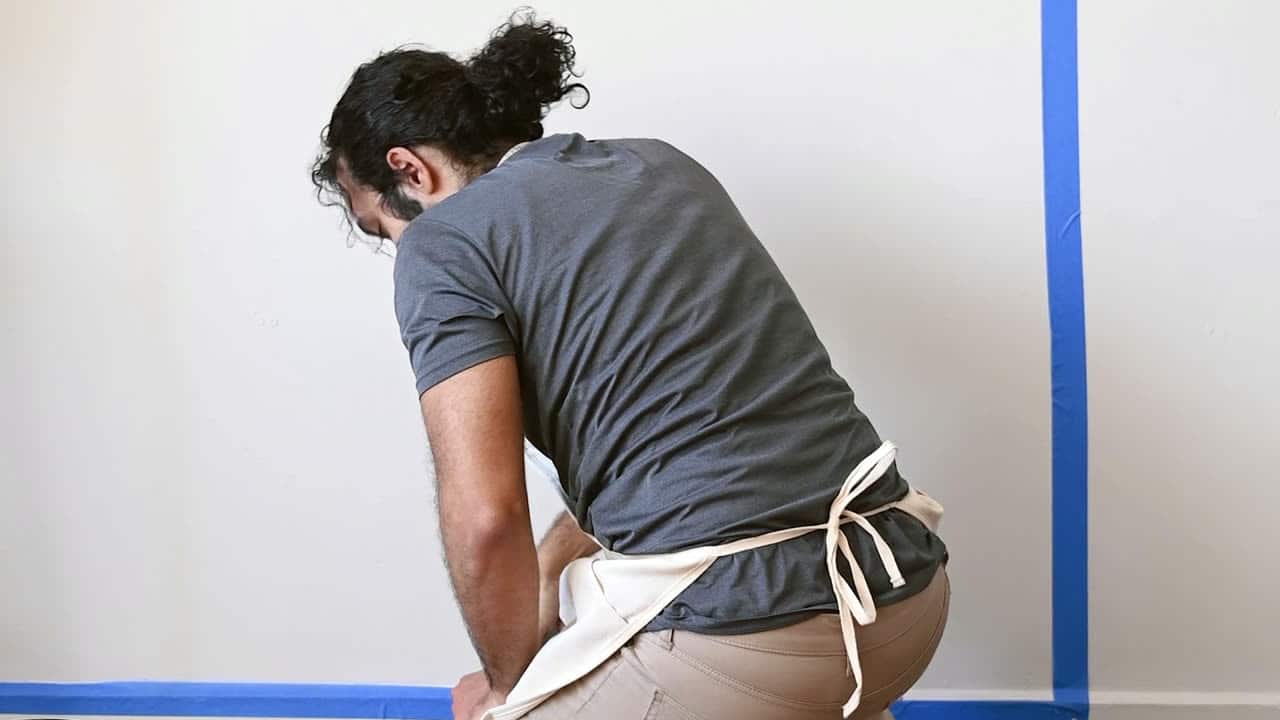
That photo up top is our own crew mid-spray — and the spray rig comes with a detail worth knowing: on surfaces that matter, spraying should be followed by back-rolling, working the atomized paint into the surface so it bonds rather than merely landing. Spray-only is fast and looks fine on day one; spray-and-back-roll is what still looks fine in year six. It is a fair question to ask any painter: “do you back-roll after spraying?” The pause before the answer tells you a lot.
Painting has the lowest barrier to entry of any trade — a ladder, a brush and a magnetic sign make a company — which is exactly why the vetting questions matter more here than anywhere. Ask what prep the price includes, in writing: washing, scraping, priming, caulk, and a rot allowance for what scraping uncovers. Ask what specific product line is being applied, not just the brand; every major brand sells a contractor-grade line and a premium line, and the difference shows up in year four. Ask who is actually painting — employees of the company quoting, or a crew the estimator has never met.
In Maryland, painting contractors need an MHIC home improvement license like any other trade, and insurance that actually covers the people on the ladders. Both are verifiable, neither is bureaucratic trivia — an uninsured painter’s fall is the homeowner’s problem in a way nobody enjoys discovering.
The structural advantage a multi-trade crew brings to painting is that paint is where every other repair becomes visible. Exterior repaints uncover rotted trim and failed siding; interior repaints uncover cracks, pops and old water scars. A painting-only company paints around what it finds or stops to refer you out; a crew that also does carpentry, siding and drywall fixes what the prep uncovers and keeps the schedule. The paint is the last coat of a repair job — it might as well be quoted by people who can do the repairs.
If you only skim
The trade behind this post
Interior & Exterior Painting
Reading because you have this exact problem? Call and describe it. You’ll get a straight answer on whether it’s something we do and roughly what it runs.
(301) 524-1729See how we do paintingOn the job
Trade photography, stage by stage. Photos of our own recent jobs come out at the walkthrough, on the actual house.


Straight answers
Not covered here? Call and ask — you’ll get a real answer, not a “depends on the job”.
Interior work is priced by the room and the scope (walls only versus walls, ceiling and trim); exterior by the square footage, the substrate and — above all — the prep condition. The painting page on this site carries the ranges we actually price to. The honest warning is about the low bid: paint jobs vary three-fold in prep hours, and a bid far below the others has almost always found its savings there, where you cannot see it until year three.
They are tools, not philosophies. Spraying lays the flattest, fastest finish on large surfaces — siding, ceilings, doors, cabinets — and a sprayed-then-back-rolled wall gets both speed and bond. Brush and roller win on detail work, trim and occupied interiors where overspray control matters. A good crew uses all three on one house; a crew that only sprays or only rolls is fitting your house to its equipment.
Inside, absolutely — winter is the best time to book interior work, and low indoor humidity helps cure. Outside, mostly no: once overnight temperatures sit below 50°F, standard acrylics stop curing properly. There are cold-weather formulations rated to 35°F that make small exterior repairs possible in a mild spell, but a full exterior repaint pushed into December is a job being done for the contractor’s calendar, not the paint’s.
Yes — dark colors absorb more UV and heat, so they fade sooner and stress the substrate more, and on south-facing walls the difference is visible years earlier. That is not a reason to avoid the navy or the charcoal everyone loves right now; it is a reason to buy the premium line in that color (better pigments resist fading longest) and to expect the sunny sides to lead the repaint schedule.
A typical exterior repaint runs three to five working days including prep, weather permitting — prep-heavy older homes run longer. Interiors: a bedroom in a day, a whole-floor repaint typically three to five days, kitchens and stairwells slower than their size suggests. Beware the one-day whole-house quote; the time being saved is the prep, and the prep was the product.
Keep reading
Other write-ups on this trade and the ones that usually come with it.
While the crew is there

Talk to the people doing the work
Tell us what needs doing. We’ll walk it with you, sequence every trade it touches, put the price in writing, and leave you to decide.
Get a quote
Two short steps. No obligation, no pressure — just a clear number and a straight answer about what the job involves.


Tick as many as you like. Most jobs are two or three of them at once, and I sort out the detail when I come and look. Nobody gets turned away for choosing the wrong box.


