Substrate prep and floor levelling
Substrate prep
Read more403 Navaho Dr, Frederick, MD 21701

Tile Flooring in Frederick & Central MD
Large tile is less forgiving, not more. The format that hides grout lines also shows every millimetre the floor underneath is out.
Quick answer
Yes, typically $2 to $5 per square foot above the $8 to $18 base labour, and the bigger variable is the floor preparation. Large tile needs a flatter substrate than small tile, so self-levelling compound at $2 to $6 per square foot or grinding at $2 to $5 is often necessary where a smaller format would have been fine. The tile also handles slower and heavier and uses a levelling clip system. None of that is padding — it is what makes the floor lie flat.
The work
Large format tile — anything over about fifteen inches on a side, and the long thin plank tiles that imitate timber — looks calmer than small tile because there is less grout in the field. What people do not expect is that it is harder to install well, and that the difficulty is almost all in the floor rather than in the tile.
A small tile can ride a gentle undulation because each unit only spans a few inches. A 24-inch tile spans the whole dip, so it bridges the hollow and sits proud at one end — and the step between it and its neighbour, which the trade calls lippage, catches light and catches toes. The flatness tolerance a large tile needs is tighter than for a small one, which means more self-levelling compound and more grinding, and that is real money the quote has to contain rather than discover.
Plank tile adds its own problem. Long thin tiles are usually slightly bowed along their length as they come out of the kiln, which is normal and within tolerance for the product, but it means a running bond offset of half a plank puts the crown of one tile against the end of its neighbour — the single worst arrangement for lippage. A third offset rather than a half, and levelling clips through the whole field, is what makes a plank floor lie flat. These are not opinions; they are what the tile manufacturers themselves specify, and ignoring them is the usual reason a wood-look floor feels uneven underfoot.
Maryland large format and plank tile, installed labour plus setting materials. Tile is a separate line. The flattening work is the real variable and is quoted after we measure the floor.
Ranges, not quotes. Real numbers come from a walkthrough — access, condition, height and finish level move a price more than square footage does. Estimates are free and in writing.
Get your numberFull large format tile cost guide for MarylandPrefer to just talk?
Call and describe the job. You’ll get a straight answer on whether it’s something we do and roughly what it runs.
(301) 524-1729
Self-performed
Large format and plank tile
What’s included
Written into the estimate, not assumed. If something on your job is not on this list, it gets priced and named before anyone starts.
The floor checked with a long straightedge and the tolerance assessed for the specific tile size, not against a general rule. A floor that is acceptable for twelve-inch tile is frequently not acceptable for twenty-four, and knowing that before the quote is what stops the prep becoming a mid-job surprise.
Self-levelling compound, grinding down high spots, or both, until the floor meets what the tile needs. This is the main cost difference between large format and ordinary tile and we would rather itemise it honestly at $2 to $6 per square foot than hide it in the rate.
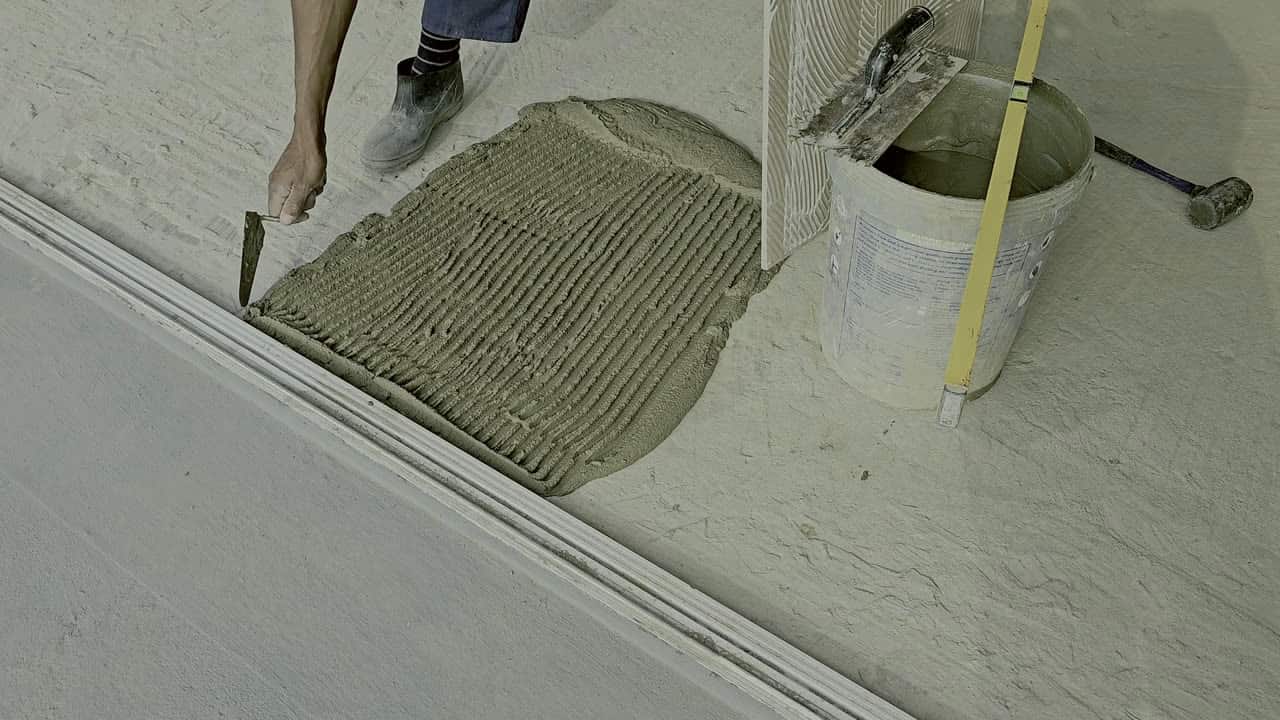
A mortar suited to large and heavy tile, combed in one direction, with the back of each tile buttered so coverage is full rather than ridged. Large tiles trap air under the centre if they are only combed, and a void under the middle of a 24-inch tile is where it cracks when a chair leg lands on it.
Plank tile set to roughly a third offset rather than a half, because the slight crown along a long tile is what produces lippage against a half-bond neighbour. Where a client wants a half-bond look we explain the trade-off rather than just doing it and hoping.
Mechanical levelling clips used across the whole installation rather than only in difficult spots, which holds adjacent tiles in plane while the mortar sets. It is slower, it uses consumables, and it is the single most effective thing available for keeping a large-format floor flat.
Large tile usually means large open floors, which need soft perimeter joints and intermediate movement joints across long runs. Layout also gets planned so the long cuts land away from the main sight line, because a cut along the length of a plank is far more visible than a cut across one.
On the job
What the trade looks like at each stage. Photos of our own recent jobs come out at the walkthrough, on the actual house.


Straight answers
Not covered here? Call and ask — you’ll get a real answer, not a “depends on the job”.
Lippage is a height step between two adjacent tiles, and on a large format floor it is the defect you both see and feel. It comes from three things: a substrate that is not flat enough for the format, tiles that are slightly bowed along their length, and mortar coverage that is uneven. The answers are, in order, flattening the floor properly, setting plank tile to a third offset rather than a half, and using mechanical levelling clips through the whole field.
From standing height, modern printing is genuinely good, and plank tile does things timber will not — it takes a wet mudroom, a bathroom and underfloor heating without complaint. Close up, the giveaways are the grout joint and the repetition of the pattern across the floor. We dry-lay enough of the field to shuffle the pattern and break up repeats, which is the part that most affects whether it reads as real.
Because tile and the substrate under it expand and contract at different rates, and an uncoupling membrane lets that happen without the stress reaching the tile. On a large-format floor, over a timber subfloor, or over an existing surface we are not tearing out, it is often the difference between a floor that stays sound and one that pops a line of tiles along a joist. It is $2 to $4 per square foot and we say when we think it is genuinely needed rather than adding it to every quote.
Same crew, same visit
Most tile flooring jobs are two or three of these at once, which is why they are priced and scheduled together rather than as separate call-outs.
From the field
Longer answers than a quote page has room for — how the work fails, what putting it right actually involves, and when waiting is the honest call.
Sources worth your time
None of these are ours. They are the offices and standards bodies that set the rules we work to, so you can verify what we say rather than take it.
Publishes the TCNA Handbook, the installation-method standard that tells a tiler which membrane, backer and mortar a wet area actually calls for.
OpenWhere the residential-construction standards and material research behind these decisions are published.
OpenCheck any Maryland contractor's licence before you sign. Ours is on file with the Commission.
Open
Talk to the people doing the work
Tell us what needs doing. We’ll walk it with you, sequence every trade it touches, put the price in writing, and leave you to decide.
Get a quote
Two short steps. No obligation, no pressure — just a clear number and a straight answer about what the job involves.


Tick as many as you like. Most jobs are two or three of them at once, and I sort out the detail when I come and look. Nobody gets turned away for choosing the wrong box.


